$2,599.00delivered
The only Source here not listed for parts, from a big US synth shop. Ask what they checked before listing it.
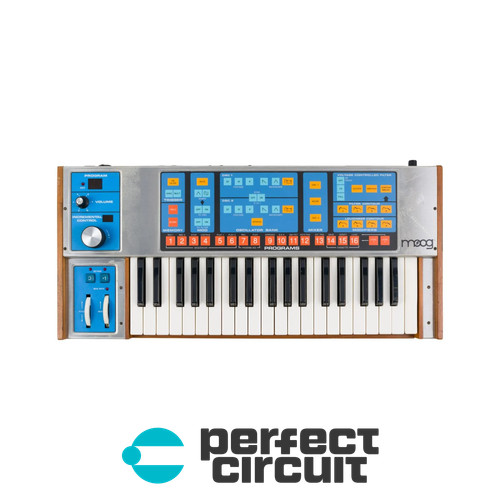
Moog Source Analog Keyboard SYNTHESIZER - VINTAGE - PERFECT CIRCUIT

Moog · Analog monosynth · Pre-MIDI classics
You program the Moog Source with one wheel. The front panel is a flat membrane of printed buttons with a single optical data wheel. You press a parameter, then turn the wheel to change it. Reviewers call it the first synth to program that way, and it looks like nothing else Moog made. It was built from 1981 to 1985. Underneath sits a two-oscillator monosynth with Moog's 24 dB low-pass filter, two ADSR envelopes, sample-and-hold and a simple sequencer, on 37 keys. It holds 16 patches and can save more to cassette, and Moog warmed the inside to about 35 degrees Celsius to keep the oscillators steady. There are CV and gate jacks but no MIDI, though aftermarket kits add it. New Order, Devo and Depeche Mode all used one. Editing is slow, since you can only change one setting at a time. Pick one whose panel buttons all respond, because parts for its digital side are hard to find.
The membrane buttons don't always respond properly, and that's the complaint you'll hear most. Service parts for its microprocessor side are hard to come by, so a dead panel or processor fault can be tough to fix.
Buying guide
A Source with a dead panel or processor is hard to fix, because parts for its digital side are scarce. That makes the two cheaper for-parts listings riskier than they look. The only working-condition one is Perfect Circuit's at $2,599 delivered, so there's no band to judge it against. Get a video pressing every membrane button and turning the data wheel slowly. The Source never shipped with MIDI, so ask who fitted any.
$2,599.00delivered
The only Source here not listed for parts, from a big US synth shop. Ask what they checked before listing it.
Moog Source Analog Keyboard SYNTHESIZER - VINTAGE - PERFECT CIRCUIT
Delivered prices include shipping as eBay quoted it to a US address on Oct 19, 2026. Many sellers charge by distance, so your total may differ. eBay shows yours before you pay.
Snapshot
Checked . Some may have sold.
Delivered prices include shipping as eBay quoted it to a US address on Oct 19, 2026. Many sellers charge by distance, so your total may differ. eBay shows yours before you pay.
Used$2,599.00delivered
$2,599.00 · free shipping
Buy It Now$2,599.00
Good buy
Not for parts, but no service mentioned.
Seller: perfect_circuit_audio
99.8% positive
 For parts
$1,650.00est. delivered
$1,550.00 + $100.00 shipping
Buy It Now$1,550.00
Our take
Listed as not working. Digital-side parts are hard to find.
Seller: berr-laur
100% positive
 For parts
$1,900.00delivered
$1,900.00 · free shipping
Buy It Now$1,900.00
Our take
Bare title, but eBay lists it under for parts or not working. Ask why.
Seller: double-d-guitars
99.8% positive
Prices change daily. The live eBay search shows everything listed now, including anything new since Oct 19, 2026.
See every listing on eBay ↗eBay search
Moog · Analog monosynth
Moog Prodigy
1979–1984 · Monophonic
Asking $1,450–$1,775 on eBay

Moog · Analog monosynth
Moog Rogue
Monophonic
Asking $1,050–$1,520 on eBay

Sequential Circuits · Analog monosynth
Sequential Pro-One
1981–1984 · Monophonic
Asking $2,325–$2,950 on eBay

Roland · Analog monosynth
Roland SH-101
1982–1986 · Monophonic
Asking $1,500–$2,150 on eBay

Korg · Analog monosynth
Korg Mono/Poly
Paraphonic (4 voices)
Asking $1,975–$2,425 on eBay